Blog
Hurricane Readiness for Home Health Patients: A South Florida Family Checklist
Hurricane Readiness for Home Health Patients: A South Florida Family Checklist
Hurricane readiness for a home health patient starts with one written plan that covers care needs, power, medications, equipment, communication, transportation, and a safe destination. Build that plan before a storm threatens. Confirm what the home health agency can do, what the family must handle, and what local emergency programs require. Do not assume a registry guarantees help or that a special needs shelter supplies medication, oxygen, or dialysis.
Here is what you need to know: even though NOAA's updated 2026 Atlantic hurricane outlook says below-normal activity is the most likely outcome this season, that forecast covers the entire Atlantic basin. It does not predict whether a storm will cross your street in Deerfield Beach, knock out your power for three days, or close the pharmacy where your loved one picks up insulin. One storm is all it takes to create a local emergency, and the August-to-October peak is right now.
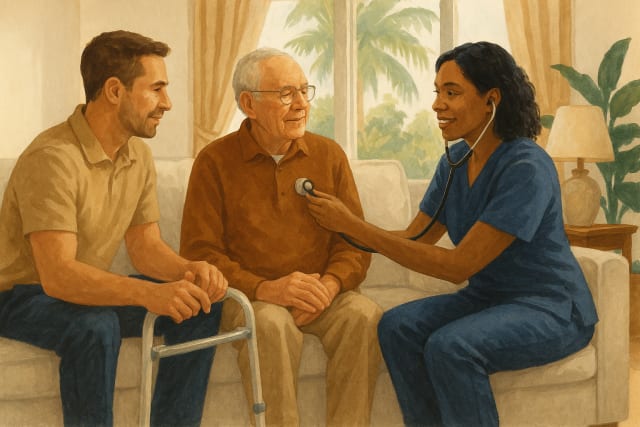
If your family member receives skilled home health services, your storm plan has to account for things most households never think about: power-dependent medical equipment, visit schedule changes, medication access, accessible transportation, and communication with clinical teams when phone lines go down. This checklist walks you through every piece, grounded in what federal and state emergency preparedness frameworks actually require, and what South Florida county programs actually offer.
Why Should You Prepare When the 2026 Outlook Favors a Quiet Season?
A seasonal outlook describes expected activity across the entire Atlantic basin. NOAA is clear that the outlook does not forecast landfall for a particular location, and that the timing and location of landfalls depend on weather patterns that become clearer much closer to an event. Below-normal does not mean no risk. It means fewer storms overall, not that South Florida gets an all-clear.
For a person receiving skilled nursing, physical therapy, occupational therapy, or speech therapy at home, the practical issue is continuity of care. A missed visit, a closed pharmacy, a power failure on your block, a blocked road, or a mandatory evacuation order can all disrupt the care plan even when your loved one's condition has not changed. The home health agency may not be able to send a clinician during unsafe conditions. The pharmacy may close for days. The medical equipment supplier's phone may ring without an answer.
Calm preparation before the season's peak gives you more choices and clearer questions to ask. Treat the seasonal outlook as context, not as permission to postpone your household plan. Follow NOAA and your local emergency management office for current storm information throughout the season.
What Makes Home Health Patients More Vulnerable During a Storm?
Most hurricane checklists assume the household can drive to a shelter, stand in line for supplies, and go a few days without medical intervention. For a home health patient, that assumption falls apart quickly. Consider the realities:
- Power-dependent equipment: Oxygen concentrators, nebulizers, tube-feeding pumps, infusion devices, and powered hospital beds all stop working when the electricity goes out.
- Mobility limitations: A patient who is homebound, meaning leaving home is a taxing effort, may not be able to evacuate without accessible transportation arranged in advance.
- Medication schedules: Skipping doses, rationing pills, or losing refrigerated medication during a power outage can create a medical emergency on top of a weather emergency.
- Communication gaps: If the home health agency cannot reach you and you cannot reach them, visit schedules, care instructions, and clinical updates all go silent.
These are not hypothetical problems. They are the specific scenarios that federal and state emergency planning frameworks are designed to address.
What Should a Home Health Emergency Plan Actually Cover?
CMS identifies four core elements for Medicare-participating providers: risk assessment and emergency planning, a communication plan, policies and procedures, and training and testing. The risks CMS lists include local hazards, equipment and power failures, communication interruptions, and loss of supplies.
Florida AHCA lists the same four planning areas and provides emergency preparedness resources for home health agencies across the state. These frameworks mean your home health agency should have a plan. But the agency's plan does not replace your family's plan.
Here is the distinction that matters: the agency is responsible for its organizational emergency response. You are responsible for your household. Where those two plans overlap, especially around communication, visit scheduling, and equipment, you need to confirm the details directly.
Questions to Ask Your Home Health Agency Before Hurricane Season
Do not wait for a named storm to have this conversation. Call the agency now and ask:
- How will you communicate with us before, during, and after a storm? Get a specific answer, not a vague reassurance. Ask for the number to use if normal lines fail.
- How will visit changes be communicated? Will someone call? Text? Is there a backup plan if cell service is down?
- What happens if a clinician cannot travel safely? Understand that no agency can guarantee visits during unsafe conditions. Knowing that in advance helps you plan for gaps.
- What should we have ready at home? The agency may have specific recommendations based on your loved one's plan of care.
Write down the answers. Put them in the same place as the rest of your emergency documents.
How Should You Plan for Medications and Medical Equipment?
This is where storm preparation for a home health patient diverges sharply from a standard household checklist. Start with an accurate, written inventory that includes:
- Medication name, dose, and schedule for every prescription and critical over-the-counter medication
- Prescribing clinician name and contact number
- Pharmacy name, address, and phone number
- Equipment name, model, and supplier contact for every medical device in the home
- Power requirements: Does the device need a wall outlet? Does it have a battery backup? How long does the battery last? What happens if it runs out?
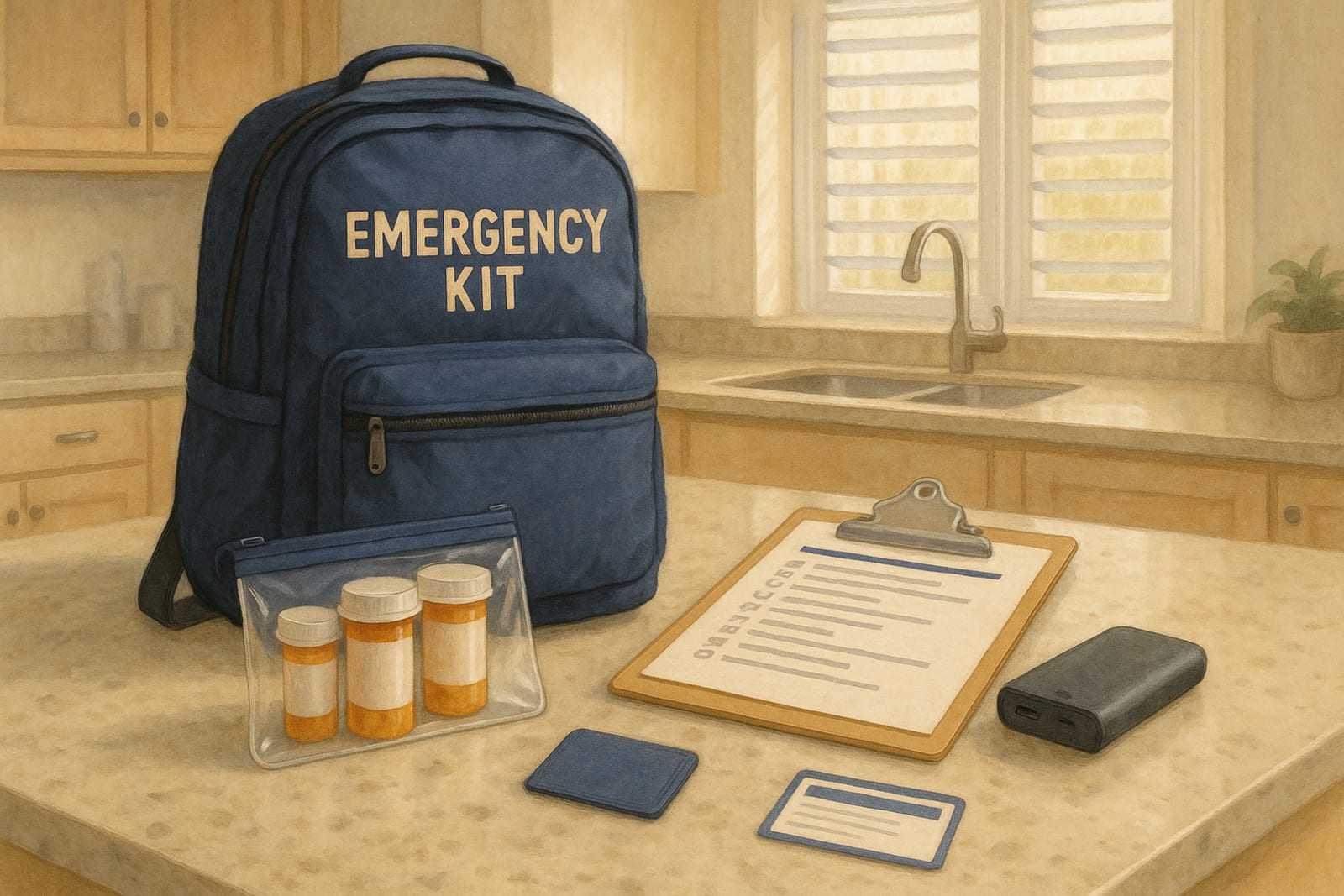
Keep this list where the patient and primary caregiver can reach it without searching. Keep a protected copy in the evacuation bag.
Medication Access During a Storm
Contact the prescribing clinician and pharmacy before a storm threatens to ask how medication access works during an emergency. Some pharmacies will fill prescriptions early when a hurricane watch is issued. Some will not. Some insurance plans allow emergency overrides for early refills. Some require a phone call.
Do not change doses, ration medication, or stop treatment on your own. If a medication requires refrigeration and power fails, ask the prescribing clinician what to do rather than guessing.
Power-Dependent Equipment
If your loved one depends on electricity for any medical device, that single fact shapes your entire emergency plan. Ask the equipment supplier what backup power or battery steps apply to the specific device. Follow manufacturer instructions and local safety guidance. A generator can solve some problems and create others; carbon monoxide poisoning from improperly placed generators is a real danger during every hurricane season.
Decide in advance: if power fails for more than a few hours, what is the plan? Does the patient go to a pre-arranged location with power? Does a backup battery cover the gap? Is a special needs shelter the right option? Make that decision now, not during a storm.
What Do South Florida Families Need to Know About Special Needs Registration?
Both Broward and Palm Beach counties offer programs for residents who may need extra help during an emergency, but these programs come with important limitations that families frequently misunderstand.
Broward County
Broward County's Vulnerable Population Registry helps municipalities understand resident needs and plan a response. Registration does not guarantee services or a priority response. It is intended for people at risk because of disability, frailty, or a health condition who plan to stay home.
Broward separately encourages people with special medical needs to pre-register for its Special Needs Shelter and, when applicable, transportation assistance. The county advises residents in an evacuation zone to follow an evacuation order. A planning registry is not a substitute for evacuation.
Palm Beach County
Palm Beach County's Special Needs Shelter Program serves residents who meet stated medical criteria. The county notes that space is limited and priority is based on need. The shelter has auxiliary power and clinical staff, but it is not a medical facility and offers limited services. Critically, the shelter does not provide medication, dialysis, oxygen, or oxygen concentrators. A caregiver must accompany the patient.
Key Takeaways for Registration
- Register early. Do not wait for a named storm. Rules, capacity, deadlines, and contact details can change.
- Confirm acceptance. Registration does not automatically mean you have a spot.
- Verify what to bring. Medication, equipment, supplies, personal items, and caregiver arrangements are your responsibility.
- Understand the limits. These programs supplement your plan. They do not replace it.
How Does Medicare Home Health Fit Into Storm Planning?
Medicare-covered home health services may include part-time or intermittent skilled nursing, physical therapy, occupational therapy, speech-language pathology, and certain other services when eligibility requirements are met. It is ordered clinical care under a physician-approved plan of care, not a guarantee of continuous attendance during an emergency.
Medicare does not cover 24-hour care at home, meal delivery, unrelated homemaker services, or custodial personal care when that is the only care needed. A patient who needs help throughout the day may also need private-duty caregiving, family support, or another arrangement. Storm readiness should spell out who will provide non-skilled help if normal routines are disrupted.
Here is the simplest way to think about it: skilled home health addresses specific clinical goals. It is not an emergency staffing service. Your storm plan should name who provides supervision, meals, mobility help, and companionship if the skilled clinician cannot visit for a day or two. That might be a family member, a private-duty aide, or a neighbor, but it should be someone specific, not a vague hope.
Your South Florida Home Health Hurricane Checklist
Print this. Fill it in. Put it in the evacuation bag. Give a copy to the primary caregiver.
- Write the patient's diagnoses, allergies, medication list, pharmacy, and prescribing contacts on one page
- List every medical device, supplier, power source, battery life, and safe-use instructions
- Ask the home health agency how it communicates before, during, and after a storm
- Record the agency's main number and after-hours number on paper and in each caregiver's phone
- Confirm which skilled visits are ordered and how schedule changes will be communicated
- Ask the prescribing clinician and pharmacy about medication access during emergencies
- Choose a primary evacuation destination and a backup outside the evacuation zone
- Confirm accessible transportation before a storm threatens
- Check whether Broward or Palm Beach special needs registration fits the patient's situation
- Read the registry limits carefully; registration may not guarantee help, placement, or transportation
- Confirm what the shelter does not supply and pack required medication, equipment, records, and personal items
- Identify the caregiver who will accompany the patient (programs typically require one)
- Protect identification, insurance cards, provider orders, and essential health records in a waterproof container
- Plan for pets separately because shelter rules and transportation often differ
- Follow official evacuation orders and local emergency instructions; do not override them
- Review the plan after any change in condition, medication, equipment, caregiver availability, or address
What to Do Now
Preparation works best when you break it into manageable steps with real deadlines.
This Week
- Build the one-page medication and equipment inventory. Name, dose, schedule, prescriber, pharmacy, supplier, power requirements. One page, both sides if needed.
- Call your home health agency. Ask how they communicate during emergencies. Write down the answer and the backup phone number.
- Check your evacuation zone. Broward and Palm Beach counties both have online zone-lookup tools. Know your zone before a watch is issued.
This Month
- Contact the prescribing clinician and pharmacy about early refill policies and emergency medication access.
- Contact the equipment supplier about backup battery options and what to do during a prolonged power outage.
- Register with your county's special needs program if your loved one meets the criteria. Confirm acceptance, requirements, and what to bring.
- Identify accessible transportation. If your loved one cannot ride in a standard vehicle, confirm who provides the ride and how much lead time they need.
This Quarter
- Do a dry run. Pack the evacuation bag with the medication list, insurance cards, identification, a change of clothes, chargers, and a paper copy of the emergency plan. Time how long it takes.
- Review the plan with every caregiver involved. Make sure the person who would accompany the patient to a shelter knows what the shelter does and does not provide.
- Update the plan if anything has changed: new medication, new equipment, new address, new caregiver, or new insurance.
- Revisit the NHC 2026 season archive periodically for official storm reports and updates.
Frequently Asked Questions
Does a below-normal hurricane season mean South Florida is safe?
No. NOAA's seasonal outlook covers the entire Atlantic basin and cannot predict whether a storm will affect a particular location. One hurricane making landfall in South Florida would create a local emergency regardless of how quiet the rest of the basin has been.
Does registering with Broward's Vulnerable Population Registry guarantee I will get help?
No. Broward County states that the registry is a planning tool and does not guarantee services or a priority response. Special needs shelter registration and transportation requests are separate steps with their own requirements.
Will a Palm Beach County special needs shelter provide oxygen or medication?
No. The county states that the shelter does not provide medication, dialysis, oxygen, or oxygen concentrators. You must bring your own supplies, and a caregiver must accompany the patient.
Will Medicare home health provide around-the-clock help during a hurricane?
No. Medicare does not cover 24-hour care at home. Ask your home health agency which skilled visits are currently ordered, how the agency handles emergency communication, and plan separately for who will cover ongoing personal care and supervision.
When should I update the emergency plan?
Update it whenever medication, equipment, mobility, cognition, caregiver availability, address, evacuation destination, or county program status changes. Do not treat this as a once-a-year exercise. A new prescription or a new power-dependent device means the plan needs a new line.
The Bottom Line
Hurricane preparedness for a home health patient is not about predicting whether a storm will hit. It is about making sure your family has one clear, written plan that covers medications, equipment, communication, transportation, and a safe destination before the situation becomes urgent. Build the plan now, confirm the details with your home health agency and your county, and update it every time something changes.
If your loved one receives skilled home health services in South Florida, the simplest place to start is one phone call to Freedom Home Healthcare. Ask us to walk through our emergency communication process, what still belongs to the family, and what should be done before a storm threatens. Reach out to our team today so your family is ready before the next watch is issued.