Blog
Home Physical Therapy That Actually Sticks: How VR Keeps Recovery on Track
Home Physical Therapy That Actually Sticks: How VR Keeps Recovery on Track
Here is something we see every week: a patient comes home after a knee replacement, does great for the first two visits, and then the wheels come off. Not because the therapy stopped working. Because the patient stopped doing it.
Ask anyone who has worked in home health for a while and they will tell you the same thing. The exercises are not the hard part. Doing them again on Thursday, when nobody is watching and the recliner is right there, is the hard part. Recovery is not really a medical problem after the first week. It is a consistency problem.
That is the honest lens to use when you hear about new technology in home health, including the virtual reality therapy tools we are bringing into our own programs. The right question is never "is this impressive?" The right question is "does this help the patient actually do the work?" Here is how we think about it.
Why Recovery Stalls at Home
When you are discharged with a referral for home health, Medicare organizes your care into what is called an episode: a period of care, typically structured in 60-day certification periods, with a plan of care written by your doctor and carried out by clinicians who come to your home.
Inside that window, there is a rhythm that works. We like to front load visits, meaning more visits early in the episode, when the risk of falling or backsliding is highest and good habits are being formed. Between those visits, the patient has a home exercise program: the work you do on the days the therapist is not there.
And that is exactly where recovery stalls. The therapist is in the home maybe three hours a week. The other 165 hours belong to the patient. A sheet of paper with stick-figure exercises is competing against pain, boredom, and a very comfortable couch. The sheet of paper usually loses.
What Actually Keeps People Doing the Work
Before we talk about headsets, credit where it is due: the strongest adherence tool in home health is not technology. It is the continuity of care. When the same clinician walks through your door visit after visit, learns your name, your goals, and your kitchen layout, you do not want to disappoint them. You do the homework because someone you know is coming back Thursday to check. That is why continuity is the thing we tell every family to look for in an agency, star ratings or not.
Technology earns its place when it strengthens that same loop: engagement, accountability, and information flowing back to the clinician.
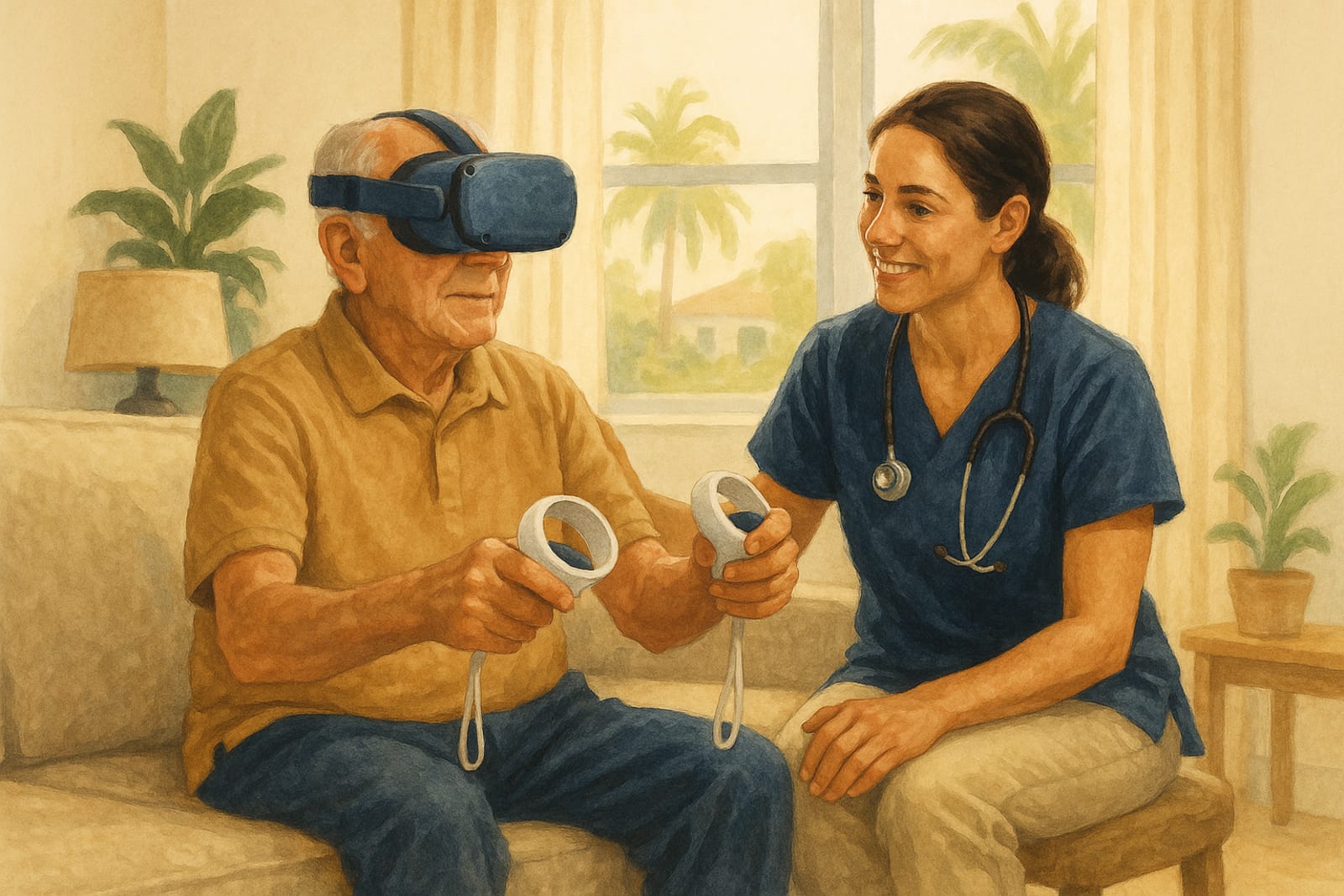
Making the work feel less like work. The virtual reality therapy we are bringing into our programs, through a company called XR Health, puts the patient in a lightweight, FDA-registered headset that ships to the home preloaded and ready to use, with no setup for the family to wrestle with. It turns therapeutic movement into interactive games and guided sessions, and the movements map to the exact goals a therapist is already working on: reaching and range of motion, bending, balance, motor coordination, hand-eye control. It is the same platform used for stroke recovery and Parkinson's treatment, so it is not a gimmick, even if it looks like one the first time you watch someone who dreaded their exercises ask to do another round. Sessions are designed to be done seated or with support, and like everything else in the home, they happen within the safety guidance of the plan of care.
Letting the therapist see the work. This is where XR Health earns its place: it runs on licensed clinicians who guide sessions remotely and see what the patient is actually doing, not just hear about it. Think of the difference between "did you do your exercises this week?" and the therapist watching your range of motion improve session by session. One is an honor system. The other is information a clinician can act on: progressing you faster when you are ready, pulling back when something looks off, and telling your doctor exactly where things stand.
Filling the space between visits. A patient who does a short guided session on the off days shows up to the next in-person visit ready to progress instead of starting over. Over a 60-day certification period, that difference compounds. The patients who stay engaged between visits are, in our experience, the ones who finish their episode strong, stay out of the hospital, and do not need to come back through the system 90 days later.
The Fine Print, in Plain English
A few honest notes, because that is how we would explain it across the kitchen table.
New therapy technology is a tool inside skilled home health, not a replacement for it. Medicare covers home health when there is a skilled need, a doctor's order, and homebound status, which does not mean you can never leave the house; it means leaving takes a taxing effort. None of that changes because a headset is involved.
Coverage for specific technologies has its own rules, and those rules are evolving. If you have heard that Medicare covers virtual reality therapy, the truthful answer is: for some devices, in some situations, with the right diagnosis and documentation, through the right channels. That is a conversation to have with your doctor and with us, not a promise to take from a blog post. What we can promise is that when we bring a tool into your care, we will tell you plainly what it does, what it costs you (often nothing), and why we think it will help your specific recovery.
And if the answer for your mother is that she would hate the headset and do her paper exercises faithfully because her therapist asked her to? Then that is the right plan for her. The goal is not technology. The goal is the work getting done.
What This Means for Your Family
If you or a loved one is heading into a recovery at home, here is what we would tell you to look for, from any agency:
Ask who is coming, and whether it will be the same clinician each visit. Ask how the agency structures visits early in the episode. Ask what happens between visits: what the home program looks like, and how anyone will know whether it is happening. And ask what tools they can bring to keep your loved one engaged, because an engaged patient is the single best predictor of a strong recovery that we know of.
Recovering at home in South Florida and wondering what your plan should look like? Call Freedom Home Health. We will walk you through what Medicare covers, what your first visits will look like, and what we can put in place, high-tech or not, to make sure the progress you make in week one is still there in week eight.